Wood Green Mall Masterplan 2026: The ~2,500-Home Retail-Led Reshape Inside Haringey’s -1.8%
Wood Green is the second structural regen story inside Haringey after Tottenham Hale, and the lender pool prices it on a different model again. The Mall masterplan supports approximately 2,500 homes consented through the post-2020 reshape of the centre. Retail-to-resi conversion finance is pricing at 70% LTGDV at 6.5 to 7.0%, and the structural shift from a 1980s shopping-centre footprint into a mixed-use resi-led centre is what carries the borough’s middle-third pricing band. The headline borough -1.8% against a Greater London -3.3% is the weighted average of three sub-zone economies — Tottenham Hale BTR forward funds at 5.0-5.5% net, Wood Green Mall conversion absorption, and the Crouch End / Muswell Hill premium-fringe backstop. Wood Green is the middle band.
The story underneath the -1.8% is two distinct sub-borough economies running in parallel inside one administrative footprint. The southern and eastern half of the borough — Tottenham, Tottenham Hale, Wood Green, Hornsey — is the north London regen engine, with Argent’s Tottenham High Road masterplan in mid-phase delivery, more than 4,000 new homes through Tottenham Hale since 2018, the new Tottenham Hotspur Stadium (opened 2019) catalysing surrounding mid-rise resi, and the Wood Green Mall masterplan with around 2,500 homes consented. The northern and western half — Crouch End, Muswell Hill, Highgate — is the premium suburban village belt holding closer to flat than the borough average, family resi with deeper end-user demand. Two stories. One borough number.
Why Haringey trades better than the London average in 2026
Most London boroughs respond to the 2026 correction by either being part of the prime central reset (K&C -11.2%, Westminster -10.8%) or by being insulated from it through outer-borough commuter dynamics (Walthamstow +5.9%, Bromley closer to flat). Haringey responds to it by carrying both sides of that split inside a single administrative footprint. Tottenham Hale, the High Road and Wood Green are absorbing institutional regen capital at the inner-fringe regen pricing band. Crouch End, Muswell Hill and Highgate are holding family-resi values closer to flat because the end-user buyer pool is structurally less interest-rate-sensitive than the leveraged investor pool driving the Hackney / Camden / Islington correction.
That is the structural reason the -1.8% sits 150 basis points above the regional benchmark. Same north London capital pool. Same NPPF and Mayor’s emergency package overlay. But the borough’s own product mix gives the lender pool somewhere institutional to deploy capital (Tottenham Hale BTR forward funding at 5.0-5.5% net) while the premium-fringe village belt acts as a value backstop on the borough average.
The Argent High Road masterplan is the structural anchor on the regen side. The Tottenham Hale opportunity area has had over 4,000 new homes through 2018-2025, the new Tottenham Hotspur Stadium opened in 2019, and the surrounding High Road footprint is in mid-phase delivery. BTR forward funding on credible Tottenham Hale schemes is clearing 5.0-5.5% net yields — broadly in line with Hackney Wick, Wandsworth Battersea / Nine Elms, and Newham Stratford. That is the borough’s standout finance story.
The Crouch End / Muswell Hill / Highgate premium-fringe pocket is the second story. Victorian and Edwardian townhouse stock at £750-1,000 per square foot in the village cores, with deep family-resi end-user demand from buyers exiting the Camden / Islington correction or upsizing within the N6 / N8 / N10 catchment. Bridging-led value-add reposition at 0.55-0.75% per month is the dominant capital flow. The premium-fringe stock is correcting closer to -1% than -10%, and that pulls the borough average toward zero rather than toward the inner-prime pace.
Reading the -1.8% in context (vs London -3.3%, vs Hackney -2.5% sister inner-east, vs Islington -4.2%, vs Walthamstow +5.9% next door)
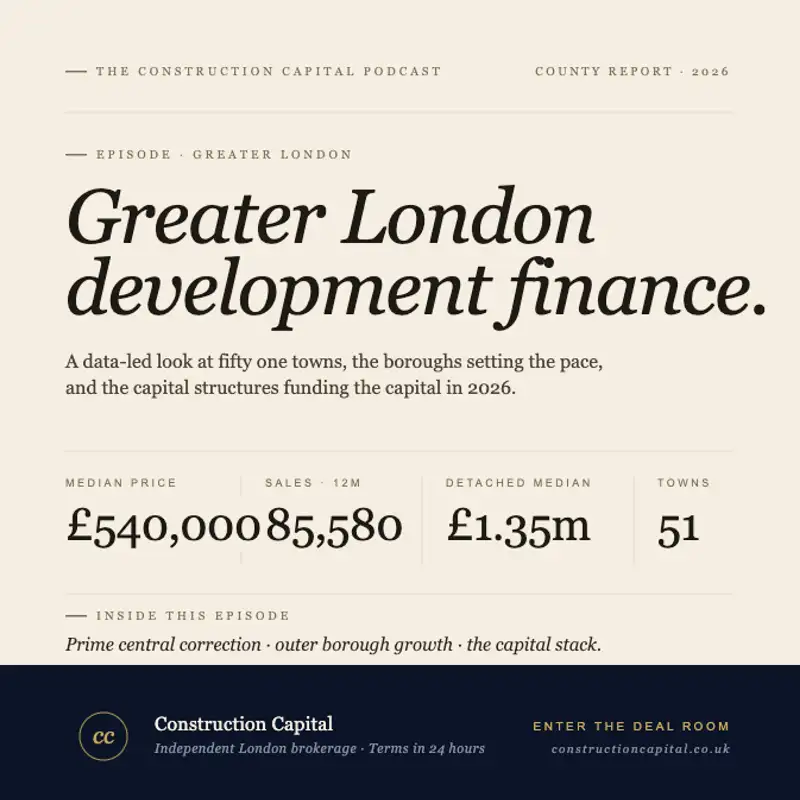
Greater London’s headline house-price index fell 3.3% year on year in February 2026 to a regional median of around £542,000 across roughly 85,580 transactions in the rolling twelve months. New-build completions ran at just 1.9% of total activity. Haringey’s -1.8% is 150 basis points above the regional benchmark.
The cleanest comparator is Hackney at -2.5% — the sister inner-east regen borough, sub-zone variance the borough average masks, similar BTR forward-fund anchoring on Hackney Wick. Haringey is 70 basis points shallower because the Crouch End / Muswell Hill village belt acts as a softer backstop than the Stoke Newington / Hackney Central spine. Islington at -4.2% is the south-side sister borough, sharing the Finsbury Park boundary and the same fringe-central pricing pool. Haringey is 240 basis points shallower because Islington carries Angel and the Clerkenwell premium-fringe drag that Haringey does not. Camden at -6.4% is the inner-NW sister borough on the diversified-stack model, sharing the Highgate boundary. Haringey is 460 basis points shallower because Camden carries the Hampstead premium correction drag and the Bloomsbury / Fitzrovia central exposure that Haringey is structurally one tier removed from.
Walthamstow at +5.9% is the immediate next-door comparator across the eastern boundary into Waltham Forest. The 7.7-percentage-point spread is roughly the spread between an inner-fringe regen borough with active institutional take-out (Haringey through Tottenham Hale) and an outer-fringe Victoria Line outperformer that had less to give back from the prior cycle (Walthamstow). Same underlying economic geography. Different cycle phase. The lender pool prices both as financeable in 2026, but on different valuation models.
The Haringey-Brent spread (Brent -2.0%, sister three-masterplan NW London regen borough) is just 20 basis points. Same hybrid mid-band borough behaviour. Same masterplan-anchored capital stack model on the regen side. Different geographic axis but the same structural read.
The sub-zone anatomy: Tottenham Hale, Tottenham High Road, Wood Green, Crouch End, Muswell Hill, Highgate, Hornsey, Finsbury Park
Tottenham Hale (N17 / N15). The borough’s structural BTR engine. Victoria Line terminus connection, Overground, National Rail. Active opportunity area with over 4,000 new homes delivered through 2018-2025, with continuing institutional pipeline. The Hale Wharf, Hale Village, Welbourne and surrounding canal-side density schemes are the dominant deal flow. BTR forward funding clearing 5.0-5.5% net yields. Senior debt on Tottenham Hale BTR-led high-density schemes prices at 65-70% LTGDV at 6.5-6.75% with the forward-fund commitment de-risking the take-out. The largest single GDV play in the borough by deal count and by quantum.
Tottenham High Road (N17). The Argent masterplan footprint. Mid-phase delivery on the wider Argent-led High Road regeneration. The new Tottenham Hotspur Stadium (opened 2019, 62,850 capacity) is the catalytic anchor — surrounding mid-rise resi-led origination has thickened materially through 2020-2025. Senior debt at 6.5% at 70% LTGDV on credible mid-rise resi-led schemes. Mid-tier resi at the £550-650 per square foot range — broadly the inner-fringe regen pricing band, with the upside coming from the masterplan absorption profile rather than the headline borough number.
Wood Green (N22). The retail-led reshape. The Wood Green Mall masterplan supports approximately 2,500 homes consented through the post-2020 reshape of the centre, with mid-rise resi-led delivery anchored on the Mall, the Piccadilly Line at Wood Green and Turnpike Lane, and the Bounds Park / Bowes Park National Rail catchment. Retail-to-resi conversion finance prices at 70% LTGDV at 6.5-7.0%. The structural reshape from a 1980s shopping-centre footprint into a mixed-use resi-led centre is the borough’s second structural growth story after Tottenham Hale.
Crouch End (N8). The premium suburban village. Victorian and Edwardian family resi at the £750-950 per square foot range. No tube station — Overground at Crouch Hill on the Gospel Oak to Barking line, plus Hornsey and Alexandra Palace National Rail within walking distance. The structural value-suppressor (no tube) is also the structural value-protector through the cycle (the buyer pool is committed to the village character and is not interest-rate-driven the way the Hackney Central / Hackney Wick investor pool is). Bridging-led value-add reposition at 0.55-0.75% per month is the dominant capital flow on the Edwardian / Victorian townhouse stock.
Muswell Hill (N10). The premium suburban village (sister to Crouch End on the western half). Edwardian family resi, Alexandra Palace catchment, no tube (closest is Highgate on the Northern High Barnet branch or East Finchley). £800-1,000 per square foot range. Bridging-led value-add at 0.55-0.75% per month. Thin new-build origination — the consented sites that exist tend to small infill or conversion product rather than mid-rise.
Highgate (N6, shared with Camden). The very-premium suburban anchor. Northern Line High Barnet branch, family resi at £1,000-1,400+ per square foot in the village core. The Haringey side carries the Highgate Wood and Queen’s Wood frontage. Premium correction on the Hampstead / Highgate axis is closer to the Camden -6.4% pace than the Haringey -1.8% pace, but the deal volume is small and the premium-fringe value-add reposition product is bridging-financed at 0.55-0.75% per month.
Hornsey (N8). Mid-tier resi-led growth corridor. National Rail at Hornsey, Overground at Crouch Hill and Harringay Green Lanes. Sits between the Crouch End premium pocket and the Wood Green retail-led reshape. Mid-rise resi-led financing at 70% LTGDV at 6.5%. The most consistently financeable mid-rise consents in the northern half of the borough by deal count.
Stroud Green (N4) / Finsbury Park (N4, shared with Islington). The southern fringe. Mid-tier resi-led, shared border with Islington. Finsbury Park Victoria / Piccadilly / National Rail interchange is the structural value-anchor — one of the best multi-line interchanges in north London. The Haringey side of the boundary carries Stroud Green and the Finsbury Park station hinterland. Senior debt at 70% LTGDV at 6.5% on mid-rise resi-led schemes.
Bounds Green / Alexandra Palace fringe (N22). Outer-fringe mid-tier. Bounds Green on the Piccadilly Line, Alexandra Palace on the National Rail. Edwardian terrace stock, smaller infill. Bridging and small mid-rise resi-led the dominant deal-flow corners.
Why Tottenham Hale is the borough’s BTR anchor
The Tottenham Hale opportunity area has been one of the most consistently delivering inner-fringe regen footprints in London through the 2018-2025 window. Over 4,000 new homes have completed through that period, with the next pipeline phase running through 2025-2028. The catchment economics are anchored on the Victoria Line terminus connection (15 minutes to Oxford Circus), the Overground orbital, the new National Rail station fit-out, the canal-side density and the proximity to the Lee Valley.
The institutional BTR forward-fund market in inner-fringe London in 2026 is structurally tight. Hackney Wick, Wandsworth Battersea, Newham Stratford, Southwark Canada Water, Greenwich Peninsula and Tottenham Hale are the six institutionally-recognised inner-fringe BTR clusters that command 5.0-5.5% net forward-fund yields. Tottenham Hale sits firmly in this band. Net yields on credible Tottenham Hale BTR-led schemes are clearing 5.0-5.5% net.
What that means for the appraisal: a Tottenham Hale BTR-led plot priced on a 5.25% net yield supports a materially higher residual land value than the same plot priced on a 6.0% open-market resi exit, and senior debt on a forward-funded scheme prices 25 to 50 basis points tighter than the equivalent open-market resi construction loan because the back-end exit risk is materially de-risked. That is the structural reason Tottenham Hale has continued to attract capital through the 2026 correction window when surrounding open-market resi origination has thinned.
The Argent High Road masterplan complements the Tottenham Hale BTR pipeline. Argent’s track record at King’s Cross gives the Tottenham High Road footprint institutional credibility on the masterplan-absorption profile, and mid-phase delivery through 2025-2028 keeps the consented pipeline absorbing senior debt at 6.5% at 70% LTGDV.
What lenders are pricing on Haringey schemes in 2026
Following the Bank of England’s December 2025 cut to 3.75%, the all-in capital stack on a typical Haringey scheme is split-tier across the borough — broadly along the regen / premium-fringe axis.
Senior development finance on a Tottenham, Tottenham High Road, Wood Green or Hornsey resi-led mid-rise scheme is pricing 6.5% per annum at 70% LTGDV. That is firmly in the inner-fringe regen pricing band — broadly in line with Hackney Central, Newham Stratford fringe and Greenwich Woolwich. On a Tottenham Hale BTR-led high-density scheme with an institutional forward-fund commitment, pricing improves to 65-70% LTGDV at 6.5-6.75% because the take-out is institutionally underwritten. On a Crouch End, Muswell Hill or Highgate ground-up resi-led scheme (rare consent, premium underwrite), pricing widens to 65% LTGDV at 6.75-7.0% because the lender pool prices the catchment more cautiously through the correction window despite the premium-fringe values holding closer to flat.
Stretched senior to 75% LTGDV is available at 7.5% on schemes with a robust cost plan and credible sponsor balance sheet. Mezzanine finance prices at 12% per annum, layered to 85-90% of cost. JV equity providers are demanding 18 to 22% IRR targets on Haringey resi-led — broadly in line with Hackney and Newham, and tighter than the inner-prime correction zone.
Bridging loans remain very active on the Crouch End / Muswell Hill / Highgate value-add reposition product. Edwardian and Victorian townhouse stock between £1m and £3m, refurb-to-rent or refurb-to-sell, 9 to 14 month construction window. Bridging at 0.55 to 0.75% per month at up to 75% LTV is the standard structure. The premium-fringe village pocket is one of the most consistent bridging deal-flow corners in north London by deal count outside of Hampstead and Primrose Hill.
The structurally active institutional product is twofold. Tottenham Hale BTR forward funding at 5.0-5.5% net yield. And Wood Green retail-to-resi conversion product at 70% LTGDV at 6.5-7.0% on credible Mall masterplan absorption. Together these absorb a meaningful share of the borough’s 2026 senior debt capacity at near-Hackney pricing — and that is the structural reason Haringey has more financed activity than Camden in 2026 despite Camden being the larger borough.
The Crouch End / Muswell Hill premium-fringe stability story
The N6 / N8 / N10 village belt is structurally less correlated with the inner London correction cycle than any other inner-fringe north London pocket. Crouch End, Muswell Hill and the Haringey side of Highgate share four reinforcing characteristics that hold values closer to flat than the borough average through 2026.
One. The buyer pool is end-user committed rather than leveraged-investor driven. Family upsizers from the Hackney / Islington / Camden inner pocket exiting into deeper N8 / N10 family-resi stock as their school-age children come through the catchment. The leveraged-investor bid that drove the Hackney Central / Hackney Wick boom (and is now driving the Hackney correction) does not anchor the Crouch End / Muswell Hill bid in the same way.
Two. The no-tube character of Crouch End and Muswell Hill is a structural value-suppressor and a structural value-protector. The premium psf is 10-15% below the equivalent Hampstead / Highgate village stock specifically because of the transport friction. That same friction means the buyer pool is highly self-selecting and committed to the village character — which translates into much lower price elasticity through the cycle.
Three. The stock is dominated by Edwardian and Victorian townhouse product, which is the most consistently financeable bridging value-add product in north London. The deal flow is granular and continuous (smaller per-unit ticket sizes, 9-14 month construction windows, single-family or HMO conversion exits), and it is much less exposed to the inner-fringe new-build resi-led origination thinning that is dragging Hackney and Camden new-build deal flow.
Four. Highgate (the Haringey side, shared with Camden) carries the very-premium anchor — Northern Line High Barnet branch, the £1,000-1,400+ per square foot range in the village core. Premium correction on the Hampstead / Highgate axis runs closer to the Camden -6.4% pace, but the deal volume is small and the premium-fringe value-add reposition product is bridging-financed and structurally counter-cyclical.
The combined weight of these four characteristics is what pulls the borough average toward zero — Tottenham Hale and the High Road regen engine on one side, the premium-fringe N6 / N8 / N10 village belt on the other, and the borough number sitting comfortably above the regional benchmark as the weighted average.
What is actually transacting in Haringey
Five categories of scheme are running across the borough in 2026.
Tottenham Hale BTR forward funds. The dominant institutional product by yield-tightness. Hale Wharf, Hale Village, Welbourne footprint, surrounding canal-side and station-fringe sites. Net yields 5.0-5.5%. Senior construction debt at 6.5-6.75% at 65-70% LTGDV with the forward-fund commitment de-risking the take-out. The single largest GDV play in the borough.
Wood Green retail-led regen. The Mall masterplan and surrounding retail-to-resi conversion product. ~2,500 homes consented through the post-2020 reshape. Senior at 6.5-7.0% at 70% LTGDV on credible mixed-use absorption product. Mid-rise resi-led component the largest by unit count.
Tottenham High Road masterplan absorption. The Argent-led High Road footprint in mid-phase delivery. Mid-rise resi-led at 6.5% at 70% LTGDV. The new Tottenham Hotspur Stadium catchment continues to thicken surrounding mid-rise resi origination.
Crouch End / Muswell Hill / Highgate value-add reposition. Bridging-financed at 0.55 to 0.75% per month. Edwardian and Victorian townhouse stock between £1m and £3m. The most consistent bridging deal-flow corner in the northern half of the borough.
Hornsey / Stroud Green / Finsbury Park fringe consents. Mid-rise resi-led at 70% LTGDV at 6.5%. Smaller per-scheme ticket sizes than the Tottenham Hale or Wood Green dominant product, but more deal-flow continuity.
What is much smaller in 2026: ground-up new-build resi-led origination on the rare consented Crouch End / Muswell Hill / Highgate sites. The capital stack on a fresh ground-up start in the village belt now requires meaningful equity (35%-plus of cost), a strong sponsor track record specifically in the N6 / N8 / N10 catchment, and a clear product differentiation argument that the lender can underwrite the trajectory through. That deal flow is real but small.
How the capital stack works on a £20-30m GDV Haringey scheme
A typical mid-cap Tottenham Hale BTR-led forward-funded scheme at this scale, with strong PTAL within a 10-minute walk of the Tottenham Hale Victoria Line terminus, a credible operator commitment and a clean planning consent under the new NPPF regime, can be financed with senior development finance at 65-70% LTGDV (around 6.5-6.75% per annum), mezzanine layered to 85-90% of cost (12%), and an institutional BTR forward-fund commitment locking the take-out at 5.0-5.5% net yield. The forward-fund commitment compresses senior pricing on the construction layer by 25 to 50 basis points relative to an open-market resi structure of the same scale, because the back-end exit risk is materially de-risked.
Blended cost-of-funds on a forward-funded Tottenham Hale BTR scheme can sit in the high sixes — meaningfully tighter than the equivalent open-market resi structure. That is the operative argument for the BTR product on the Tottenham Hale catchment specifically.
On a Wood Green retail-to-resi conversion or a Tottenham High Road mid-rise resi-led scheme of the same scale, the structure shifts to senior at 70% LTGDV at 6.5-7.0%, mezzanine to 85-90% of cost at 12%, and an open-market resi or partial BTR take-out underwritten on inner-fringe regen comparables. Blended cost-of-funds in the high sevens. Workable for credible mid-rise consents, with the Wood Green Mall masterplan absorption profile providing the institutional-flavoured backstop.
On a Crouch End or Muswell Hill ground-up resi-led scheme of the same scale (rare), the structure shifts to senior at 65% LTGDV at 6.75-7.0%, mezzanine selectively at 12%, and an open-market resi take-out underwritten on premium suburban village comparables. Blended cost-of-funds in the high sevens to low eights. Open-market exit risk on the back end, which is the structural reason the lender pool prices the village belt more cautiously than Tottenham Hale despite the Crouch End values holding closer to flat through the correction.
What this means for site acquisition
If you are pricing land in Haringey in 2026, three things matter more than they have in any recent cycle.
One, the sub-zone is the appraisal, not the borough. A Tottenham Hale BTR forward-fund plot runs on a 5.0-5.5% net yield with institutional underwrite. A Wood Green Mall conversion plot runs on Mall masterplan absorption with retail-to-resi take-out. A Tottenham High Road mid-rise plot runs on Argent-anchored masterplan absorption. A Crouch End or Muswell Hill value-add reposition runs on premium suburban village comparables in the bridging market. A Hornsey or Stroud Green mid-rise scheme runs on inner-fringe regen growth comparables. Same borough, multiple valuation models, materially different residual land values. Underwriting all of them is the discipline.
Two, the institutional product (Tottenham Hale BTR forward fund at 5.0-5.5% net yield, Wood Green Mall masterplan retail-to-resi conversion) is in the institutional sweet spot for inner-fringe north London and is the structural product the borough is optimised for through 2025 to 2030. If you have a Tottenham Hale plot that supports the BTR yield calculation with credible operator commitment and rental tone, or a Wood Green plot that supports the conversion absorption profile, that is a financeable product on better terms than an open-market resi structure on the same plot.
Three, the post-NPPF planning regime, the Mayor’s emergency package and the Time-Limited Planning Route together favour Haringey schemes that move quickly through to delivery. The borough is one of the most pipeline-rich in inner-fringe north London (Tottenham Hale opportunity area + Wood Green Mall masterplan + Tottenham High Road Argent footprint) and the regulatory tailwind through 2026 is meaningful for any consented site in the regen sub-zones.
For full borough-by-borough sold price data, the Tottenham Hale opportunity area pipeline references, the Wood Green Mall masterplan phasing detail and the underlying capital stack benchmarks behind this analysis, see the Greater London Property Market Report 2026. Borough-specific intelligence sits on the Haringey location page.
See also: Walthamstow +5.9% on YouTube and The £650/sq ft Cliff on YouTube.
Listen to the full episode
For the dedicated deep dive on this borough, we have published a stand-alone Haringey episode of the Construction Capital podcast: Haringey -1.8%: Tottenham Hale Regen, Crouch End Premium Fringe and the Wood Green Retail-Led Reshape. Around ten minutes covering the two-story borough read, the Tottenham Hale BTR forward-fund yields, the Argent High Road masterplan, the Wood Green Mall masterplan, the Crouch End / Muswell Hill premium-fringe stability story, the full April 2026 capital stack, and what is actually transacting in 2026.
This article also draws on Episode 2 of the Construction Capital podcast: Greater London Property Development Finance 2026: Market Analysis, House Prices and Lending Outlook. The full borough-level data, policy detail and capital stack discussion runs 15:30, with chapters covering Walthamstow, Bromley, Hackney and the inner-north boroughs within the wider Greater London outlook.
Listen anywhere
Listen on Apple Podcasts, Spotify, Overcast, Pocket Casts, or Amazon Music.
For indicative terms on a Haringey scheme within 24 hours, submit through the Construction Capital deal room. Construction Capital sources terms from over 100 lenders across development finance, bridging, mezzanine and equity.
Published by Construction Capital, an independent capital advisory brokerage sourcing terms from over 100 lenders across development finance, bridging, mezzanine, and equity. This article is part of the Greater London 2026 series accompanying the Construction Capital podcast.